Most owners never check.
Big boat? You will need more than a bigger trailer
More Kiwis are stepping up to 7m+ boats – and discovering that the trailer is where the real engineering happens. Once a trailer’s gross vehicle mass (GVM) goes over 3500kg, it’s legally a heavy vehicle in New Zealand. That means a Certificate of Fitness (COF) instead of a WOF, road user charges, certified heavy-vehicle braking, tow coupling, load anchorages, and in most cases a Class 2 licence to tow it.
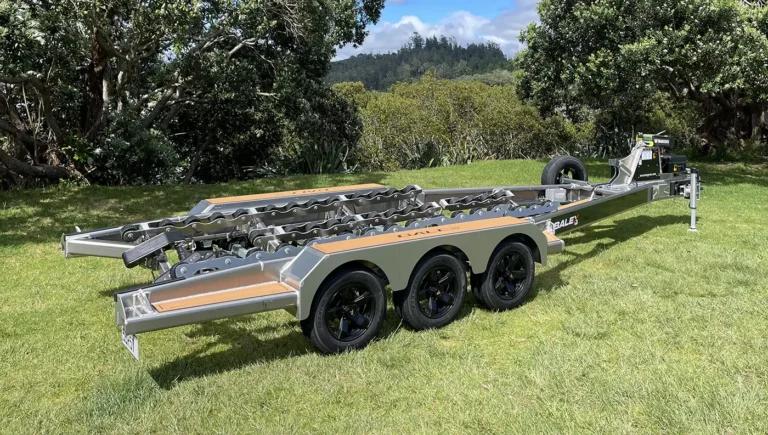
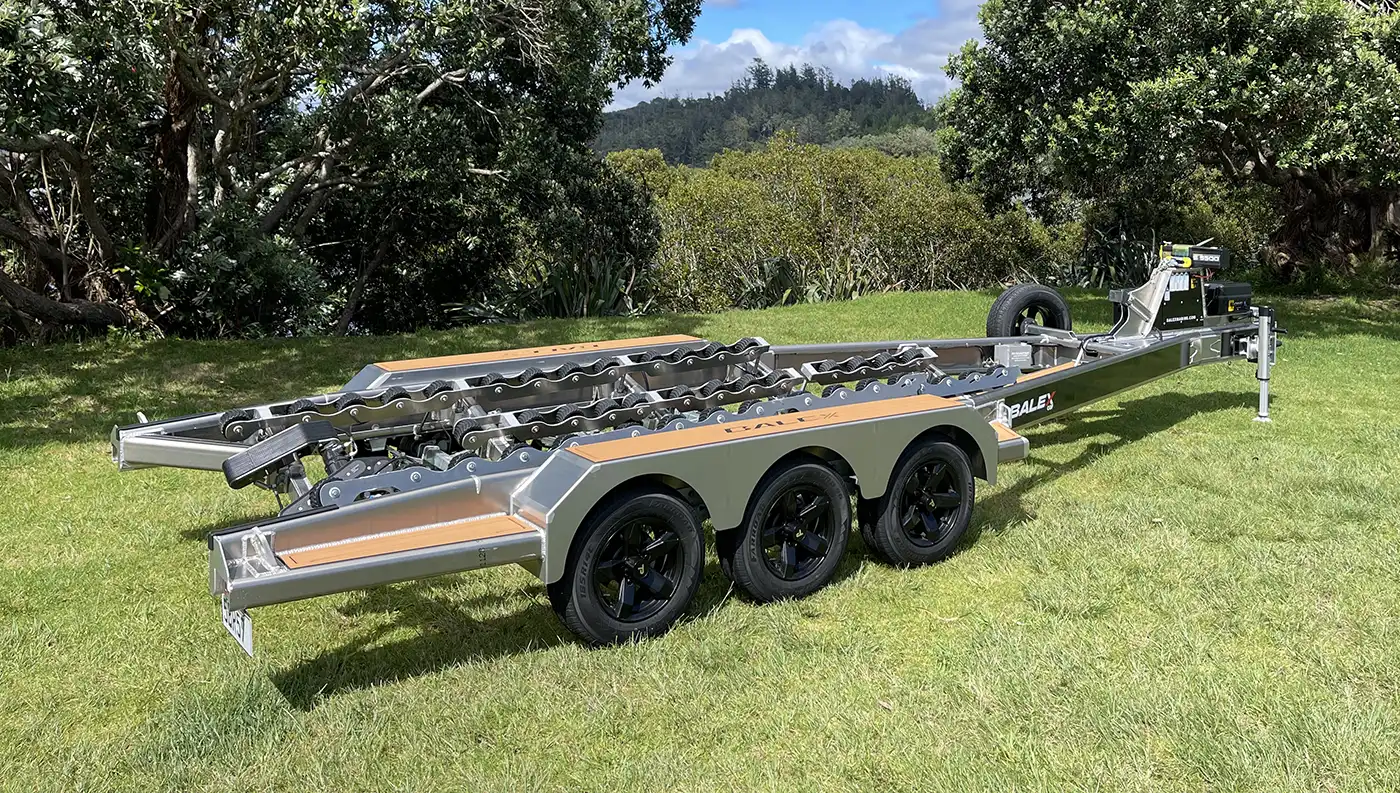
Here is an example of exactly this kind of build: a Balex Trailer 770, COF-rated to 4500kg, paired with the client’s RAM 2500. Watch it in action, then read on for everything you need to know before ordering a COF trailer for your new boat.
Featured Build
Balex Trailer 770 - 4500kg COF Rated
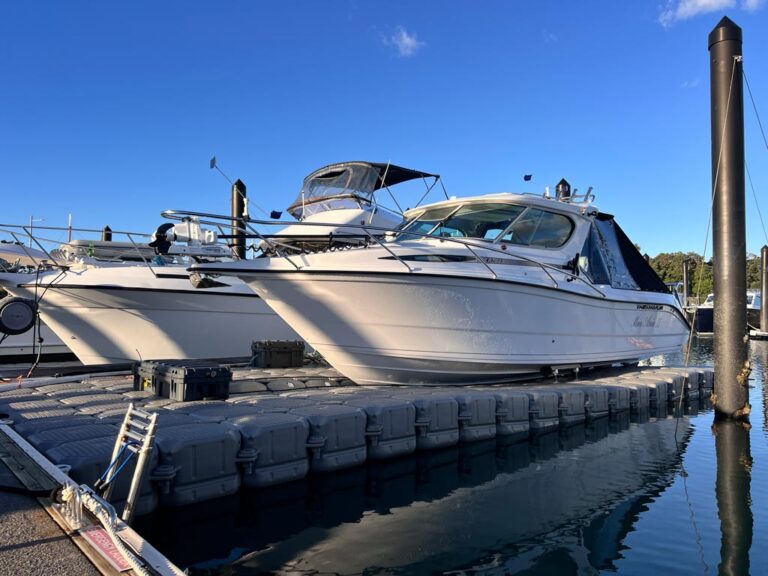
Here is the interesting part: as standard, our client’s 7.7m boat package actually came in under 3500kg. He could have run it on a WOF trailer, until the first big trip. Full fuel, dive bottles, camping gear, the toys, that is how real boats get used, and it is how owners quietly end up towing overweight and illegal.
He wanted to load up for a week away without doing maths at the boat ramp, so we built him a Balex 770 engineered, certified and COF rated to 4500kg GVM, towed by his RAM 2500 on a pintle hook, the coupling that unlocks the RAM’s maximum tow bar rating of up to 6942kg.
- 4500kg GVM rating - roughly 1000kg of legal headroom over a standard trailer
- Heavy vehicle braking system to NZ heavy vehicle brake standards
- Designed, built and certified in NZ for COF compliance from day one
- Matched to the tow vehicle - couplings, ratings and weights all checked against the RAM 2500's specs
The Rules
What is a COF trailer & do you need one?
In New Zealand, a trailer with a GVM over 3500kg is classed as a heavy trailer. Heavy trailers cannot run on a Warrant of Fitness, they need a Certificate of Fitness (COF), inspected every six months at an approved heavy vehicle testing station.
Rule of thumb: add up your boat, motor, fuel, gear and the trailer itself, as you actually tow it, not as it left the showroom. If the load on your trailer’s axles and coupling is likely to exceed 3500kg in real world use, you are in COF territory. Many 7m+ boats sit under 3500kg as standard but blow past it once loaded with full fuel, water, dive gear and camping kit.
Worth noting: the noseweight, the downward force your trailer puts on the tow ball or coupling, counts toward your trailer’s total GVM, and must also stay within your tow vehicle’s specified coupling load limit. Towing over your trailer’s rated GVM is illegal and can compromise your insurance. A COF rating buys you the headroom to load up and stay legal.
Roadside checks - what Police can do
Under section 125 of the Land Transport Act 1998, Police can require any vehicle they suspect may be a heavy vehicle to stop and be weighed. If a loaded trailer appears to be at or over 3500kg GVM, even if it is registered as a WOF (light) trailer, it can be pulled over and weighed. Police can weigh the full combination or separate the vehicles and weigh each independently to check compliance against GVM or gross laden weight. Unsafe loading is also an offence under sections 6 and 9 of the Land Transport Act 1998, enforceable by Police regardless of whether the vehicle is classified as light or heavy.
What a COF trailer must have
Certified heavy vehicle brakes – Heavy trailers first registered on or after 1 July 2008 generally require brakes matched and certified between the tow vehicle and the trailer.
Engineering certification – The design and build must be signed off by a heavy vehicle specialist certifier (LT400) before the trailer can be certified for the road.
Six monthly COF inspections – At an approved heavy vehicle inspection site, and the trailer must be kept at COF standard at all times.
Road user charges (RUC) – Heavy trailers pay distance based RUC, bought in 1000km blocks, like any heavy vehicle.
The numbers that matter
GVM, GCM and tow ball weight
GVM (gross vehicle mass) is the maximum total laden mass of a trailer, including everything on board and the noseweight transferred to the tow vehicle’s coupling. GCM (gross combination mass) is the maximum the tow vehicle and trailer can weigh together.
A third number that is easy to miss: maximum vertical coupling load (noseweight), the downward force the trailer exerts on the tow ball or pintle hook. This is rated separately by the tow vehicle and coupling manufacturers, and must not be exceeded regardless of where the trailer’s GVM sits. All three numbers must stack up, a trailer rated to 4500kg is no use behind a tow vehicle that cannot carry the coupling load safely.
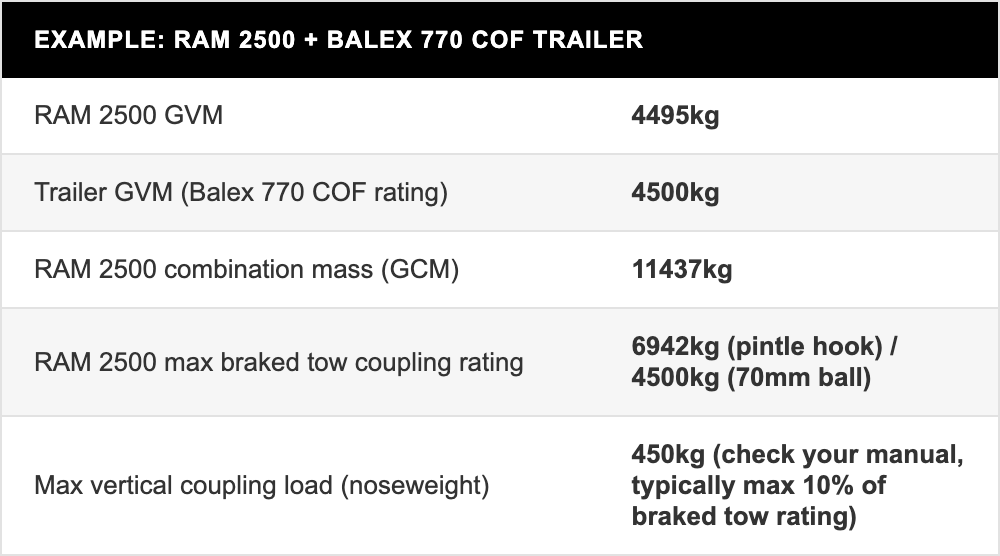
This is why tow vehicle choice and coupling choice matter. Most standard utes max out at 3500kg braked. The RAM 2500 tows 4500kg on a 70mm ball, but fitted with a pintle hook (as on this build) it is rated up to 6942kg, with approx. 12,750kg GCM on the latest models, comfortable, legal margin for a 4500kg COF boat trailer. The trailer’s coupling must be engineered and certified to match.
The 1.5:1 mass ratio rule - a critical check for big boats
Under the Land Transport Rule: Vehicle Dimensions and Mass 2016 (clause 3.14), when a light vehicle tows a heavy (COF) trailer, the trailer’s gross mass must not exceed 1.5 times the gross mass of the towing vehicle. This is a legal cap, not just a recommendation.
In practice, to legally tow a 4500kg COF trailer, your tow vehicle needs a GVM of at least 3000kg. The RAM 2500’s 4495kg GVM gives a maximum permitted trailer gross mass of 6742kg, well clear of the 4500kg Balex 770 COF. But many popular dual-cab utes have a GVM of 2800 to 3200kg, which puts a 4500kg COF trailer at or beyond their legal towing limit. Always confirm the ratio before committing to a tow vehicle.
Licensing: when a car licence isn't enough
On a full Class 1 (car) licence, you can tow a combination only up to 6000kg total, the GVMs of the tow vehicle and trailer added together must not exceed 6000kg. A RAM 2500 (approx. 4495kg GVM) towing a 4500kg rated COF trailer is a combination of roughly 8990kg, well over the Class 1 limit. To tow it legally, you need a Class 2 licence, which covers combination vehicles up to 12,000kg GCW.
Getting a Class 2 is straightforward for most experienced drivers: hold a full Class 1 (time requirements vary by age), pass a theory test for the learner stage, then complete an approved course or practical assessment for the full licence. Many of our COF trailer clients complete it in a few weeks.
Before you order
Quick Checklist
- Know your true towing weight: boat, motor, fuel, water, gear and trailer. Don't guess, weigh it or work it up from specs.
- Check your tow vehicle's braked tow rating, GVM and GCM, and the tow ball/coupling rating.
- Over 3500kg all up on the trailer? You are in COF territory, budget for six monthly inspections and RUC.
- Check your licence class, over 6000kg combined means Class 2.
- Confirm the 1.5:1 mass ratio, your tow vehicle's GVM must be at least two thirds of the trailer's gross mass. Many utes cannot legally tow a 4500kg COF trailer.
- Talk to us early, designing the trailer alongside your boat purchase avoids expensive surprises.